
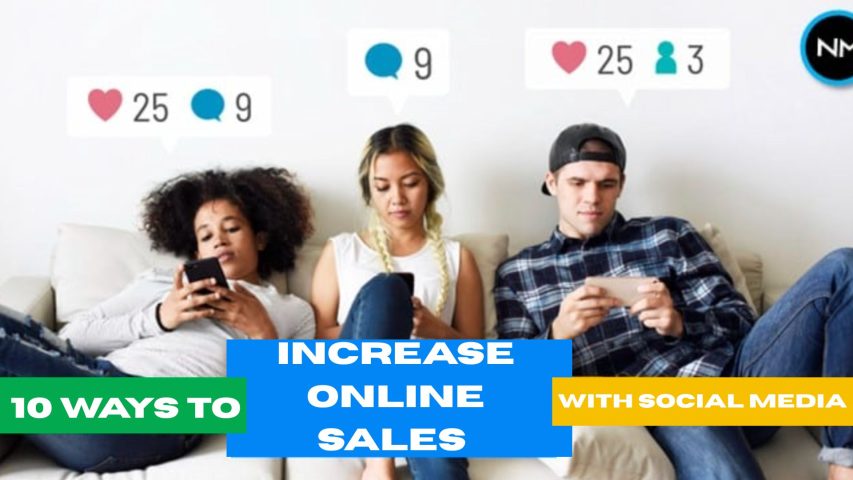
Social media is the most important marketing tool for businesses. You probably already know that most (if not all) of your current and potential customers use social media. There are more than 3.8 billion Internet users, and over 2.4 billion of them are active on social platforms. Online sales are gradually tipping the balance and becoming consumers’ preferred way to shop.
As online shopping becomes more popular, retail brands are looking for ways to better connect with their audience through an effective sales plan. Whether the goal is to drive them to your online sales page or to your social media channels, the objective is to connect with potential and paying customers on another level to ensure brand growth.
In this article, you will learn some of the most effective methods for using social media to boost sales and ensure a better return on investment.
Understanding the importance of online sales means understanding our target audience. Although the main function of social media is not to generate sales, it is to build brand awareness and establish relationships with potential and paying customers. While many of these relationships generate direct revenue, others also play an important role in increasing indirect income.
That said, you can use social media to increase your online sales—but only if you adapt your approach to the channel and its audience.
Each platform presents its own challenges and therefore requires a different strategy. Like any other marketing channel, there is a defined learning curve to generating sales on each one.
With so many social media platforms available, how do you know which ones to use and what type of content to create or publish for each?
Here are some tips:
Facebook is used by almost everyone, but its main users tend to be an older audience. Content should be longer in terms of videos and captions, as it is a strong platform for storytelling.
Instagram has an audience mainly made up of millennials and generally a younger market. Content should focus on images and aesthetic storytelling.
Snapchat also targets a younger audience. Content consists mainly of short, entertaining real-life videos.
Pinterest is ideal for providing more detailed product information and tips, such as recipes, DIY projects, etc.
Twitter is known for brief but dynamic, witty, and precise messages through tweets.
LinkedIn is used by business professionals, mainly for recruitment.
YouTube is for long-form, informative, and entertaining videos.
TikTok is where you can unleash your brand’s creativity with videos under one minute.
In general, Instagram works best for most purposes, Facebook and Pinterest are excellent for driving purchase intent, and Twitter, Snapchat, and TikTok are used to build anticipation.
If you prioritize and invest in the right platform to reach the right audience, your chances of increasing sales are much higher because you’ll be reaching the right people.
No matter which social network you use, images are absolutely essential for marketing. Blurry, low-quality images simply won’t perform well—neither on social media nor on your online sales page.
If you already have professional product photos, that’s a great start. However, your social media account should not just be a product catalog.
In almost all successful brand accounts, you’ll see plenty of professionally shot and edited images of products displayed and used artistically. Make sure to enrich and validate your offer with sharp, attractive visuals.
While it’s important to build your own follower base on social media, many companies also use social influencers to increase sales.
These individuals have large numbers of active followers. Today, people trust influencers more than their own family and friends—so much so that nearly 50% of consumers rely on influencer recommendations and purchase products after seeing them on social media.
The opportunities are endless, but if you want to boost sales, an effective strategy is to have influencers promote unique discount codes.
The key is to have them strategically feature your product in their photos or videos, or tell a unique and compelling story about your brand. You can also work with influencers who offer honest reviews of your product and/or provide tutorials and content related to its use.
This creates a great opportunity for companies to reach new audiences and influence major consumer groups such as millennials and Generation Z.
User-generated content (UGC) is content created and shared by your followers and customers on social media, either organically or through contests and giveaways.
Does UGC work for e-commerce? Absolutely! According to Business Insider, consumers who encounter this type of content are 97% more likely to convert than those who don’t.
User-generated images (photos created by customers using your products) are especially powerful. People prefer UGC because they can easily relate to a customer like themselves, compared to a professional photo taken by the company.
UGC is an excellent way to validate social proof—the psychological phenomenon where people unconsciously imitate the actions of others—and it is also a proven way to increase sales.
Studies have shown that the average consumer begins to lose focus after about eight seconds. This makes the first encounter with your content even more important, so your message needs to get straight to the point.
When designing your digital marketing strategy, keep changes in consumers’ attention spans in mind.
People generally prefer reading short paragraphs, and most prefer engaging with videos (rather than static content) that capture their attention immediately. Therefore, you should aim to:
Create and publish videos between 30 seconds and 2 minutes maximum.
Hook viewers within the first 5 seconds.
Use carousels and a variety of social ad formats.
Follow the 20% text rule.
We live in a mobile-first world, and people use their phones more than ever. For businesses, this means all digital marketing should be designed to maximize the customer experience on mobile devices.
As society continues to move in this direction, social media platforms are adapting as well. Facebook Shop and Instagram Shop are great examples of revamped social platforms designed to complement the rise of online sales and stand out from traditional online sales pages.
Keeping up with changes in social media algorithms and user experience optimization opportunities can be challenging. However, these changes are designed to support customers on their social media journey by directing them to the content they’ll find most valuable.
Here are some tips to beat Instagram’s algorithm (most of which can be adapted to other platforms):
Encourage interactions using story stickers.
Spark conversations with engaging captions.
Cross-promote content to maximize engagement.
Optimize hashtags to reach relevant communities.
Always check that your latest post looks just as good on mobile as it does on desktop, and make sure it’s visually impactful.
Native chat (or “conversational commerce”) involves using each platform’s messaging services to automate, personalize, and adapt communication.
With higher retention and engagement rates, these apps have quickly become preferred options for customers who want to connect more directly with businesses. In other words, if you’re not using chat apps to automate confirmations—and even sales—you’re missing out on a major online sales opportunity.
However, caution is needed with automated chat applications (such as Facebook Messenger bots). It’s very easy to cross the line from human to inhuman conversational commerce.
For example, using native chat to automate frontline sales is not ideal. But when people communicate with people, the benefits can be enormous. It’s all about making smart use of digital tools.
Your marketing efforts and strategies are incomplete without analytics. Analytics are essential because they help measure the impact of marketing strategies and plan your brand’s future.
By using social media analytics, you can measure the effectiveness of your strategies and evaluate what needs improvement to increase online sales conversion rates.
It’s important to consolidate all your data into a single view for deeper insights. However, since digital advertising runs across multiple platforms, data consolidation can be time-consuming and complex—especially when running multiple campaigns on different platforms.
You might not know this, but most social media platforms now allow customers to purchase and check out directly from a post.
Shoppable posts enable users to make fast and secure purchases while browsing their feeds.
This not only reduces a multi-step process to a single click but also minimizes the time customers have to reconsider their purchase decision.
Several social platforms now allow business owners to include products in a “shop” section, which is very easy to set up.
They also offer product catalogs where businesses can showcase their best products and allow customers to purchase directly from the page.
This fast and efficient process enables instant conversions and purchases, benefiting both businesses and customers. It significantly increases product reach, maximizes revenue, and even encourages repeat purchases.
Unlike traditional marketing efforts, social media marketing is completely different. Your followers need to see new, entertaining content regularly.
People are usually on social media during their free time, so they prefer entertaining posts rather than pushy content that forces them to buy something. Creating valuable content that doesn’t always sell but instead educates and engages customers adds value to their experience with your brand.
If posts are too “salesy,” people will quickly scroll past them. You must find the right balance between promoting products and keeping content engaging.
Here are some ways to do that:
Create interactive content like contests, giveaways, or polls that encourage comments.
Use funny or animated photos, videos, and GIFs.
Post photos or videos inspired by real-life situations.
Add jokes or humor to create fun content.
Share content with recipes or tips on how to use your products.
Post photos of customers using or interacting with your products.
As you can see, social media is a powerful tool you can use to promote your brand and increase sales. By leveraging different social media platforms, you can boost sales without spending a lot of money.
These are some of the most effective ways your brand can increase sales using social media. The main idea is to earn your target audience’s trust through others—both influencers and customers.
You simply need to ensure your brand is highly visible to a relevant audience, take advantage of engaging content that attracts and motivates potential customers to try your products or services.
It’s also crucial to make purchasing as easy as possible through social media platforms whenever the option is available. Designing a successful social media sales plan means minimizing friction or extra steps that could discourage people from making a purchase.
Leveraging social media to get people to invest in your products requires one simple but fundamental action: be social.
Miami, Florida | Bogota, Colombia


